

One of the best local bookstores in my area is a shop called Nooroongji. There you can find books in multiple languages, including picture books whose original texts are written in Arabic, Japanese, Korean, and Vietnamese, for example. It’s a good thing this shop doesn’t have comfy seating. If it did, I’d spend hours discovering words in Nooroongji’s large selection of picture dictionaries. Nooroongji is the English transliteration of a Korean word for the crunchy, scorched rice found at the bottom of the pot. It’s a beloved treat in many cultures and a great name for a bookstore that’s all about sharing languages and cultures.
Multilingual friendships and families build bridges between languages. Between worlds. Their connections inspire and transform society. But stepping outside one’s heritage, or having multiple heritages, can also divide people from a sense of place and belonging. This is especially true of children, whose abundance of mirror neurons are constantly busy connecting the dots between self and the world. Without familiarity of place and voice, children may lose touch, become fragmented and unsettled. Building an integrated personality from a complex network of locations and languages requires enormous effort and deep self-reflection. The resulting concept of home is broader than land. Vast and uncontained, it is more like the ocean or sky, uneasy to settle except by imagination.
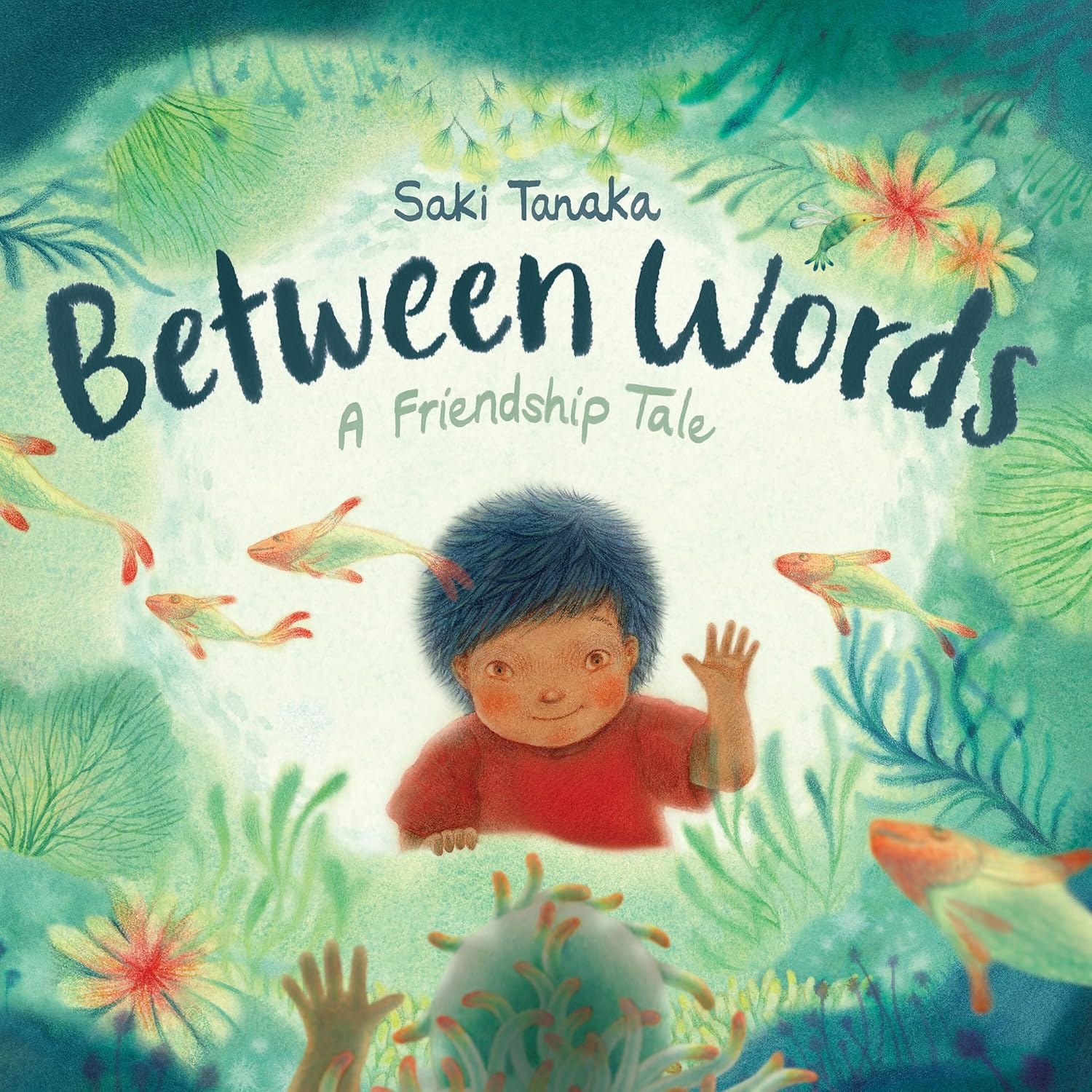
Between Words: A Friendship Tale by Saki Tanaka tells the story of Kai, a boy that follows the seasons with his Pa. They move from windy plains, to lapping lakes, and dusty villages, never staying long. At every temporary campsite, Kai builds a tower with nearby rocks before placing his own special rock on top. The stones in the tower become symbolic of things Kai wishes he had. “Words. Friends. Home.” When it is time to leave, the special rock, speckled with stars, goes with Kai while the others remain scattered behind.
Village by village, Kai’s isolation grows. Other children do not understand his language and sometimes run away. In a moment of frustration, Kai loses his speckled stone in a pool of water, forcing him to dive in and retrieve it. Under water, a whole new world presents itself. Occupied by a merfriend and a helpful school of fish, the watery underworld symbolizes a realm of imagination or place of self discovery. A span of seven wordless spreads shows Kai collecting rocks and building a large tower with the merfriend and fish. When it is finished, his speckled stone is placed on top and Kai returns to land. The sense of belonging he carries back immediately translates into a smile, which happens to work just as well as words when making new friends.
An author’s note at the end of the story explains how the author-illustrator drew from personal childhood experiences. Half Japanese, half Mexican, Saki Tanaka grew up between words and worlds. She often felt isolated and out of place, but recalls the many times she was “saved by a smile or wave that wordlessly” spoke of belonging. She writes:
“‘Kai’ means ‘ocean’ in Japanese. The name carries my hope that, like this large body of water, what separates us can also connect us. I’m heartened by kind gestures that build these bridges across all sorts of barriers and borders.”
Tanaka’s message reminds me of Nooroongji and its efforts to build bridges between worlds in the heart of a multilingual city. It also reminds me of Leanne Betasamosake Simpson’s newly released Theory of Water. An engaging and informative read, Theory of Water offers a water-driven, rather than land-based, decolonization thesis. Personal narratives that exist in a global context without connection to land are like a rising tide, flooding world languages. Wordless forms of communication may serve as flotation devices for a time, but with so many fascists patrolling the seas with their gunboats and surveilling the sky with their satellites and drones, a larger vocabulary of connection will have to surface. Unfortunately, this will increase dependencies on industrial communication services like social media and AI, which have been designed to trap or barricade our attention.
If there’s one point to be drawn, it is that we need to be more adventurous in our capacities for self-reflection and meaning making.