

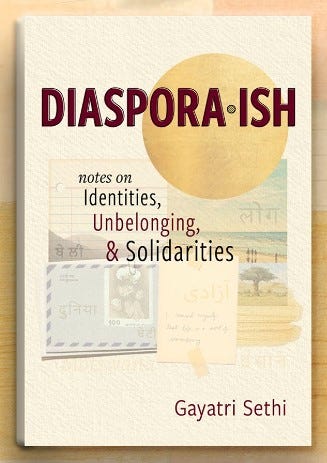
Many thanks to First Person Press, a nonfiction imprint of Sambasivan & Parikh, for an advanced reading copy of the imprint’s first publication, Diaspora-ish: notes on Identities, Unbelonging, & Solidarities, set for release on February 3rd, 2026.
Written by educator Gayatri Sethi, Diaspora-ish “draws upon [the author’s] complex diasporic journey to explore widely accepted ideas about identity and belonging.”
What does it mean to be in diaspora? How do our identities and aspirations for belonging unfold during times of collective upheaval?
Allow your imagination to linger on the idea of collective upheaval for just a moment. Perhaps some words or images come to mind, facts and opinions, points of view. Alternatively, you may experience mind blankness. Your breath sharpens. A familiar pulsing headache returns. An entanglement of previous histories, traumatic upheavals of empire, may wriggle inside, desiring or not desiring to be spoken. Perhaps survival is your ability to grasp on to something. Perhaps it is your capacity to let go. Identity expands and contracts, navigating the instability.
Narratives born out of collective upheaval are often labelled or categorized as “diaspora narratives.” The -ish in this particular book wiggles under border fences, smudges the lines of division, and refuses to march lock-step with imperial categorizations of humanity.
“To be diasporic means to be constantly entangled with the machinations of imperialism.”
Despite some heavy themes, Diaspora-ish is an effortless read thanks to author’s careful attention to flow and structure. Concepts move in fluid, intimate verse, with pauses for learning and reflection that become more expansive as the narrative weaves on. Nearly a memoir in free verse, the work explores three areas of identity in which the author has felt both affinity and estrangement. In the vastness of her experience, Sethi is desi-ish, African-ish, American-ish. The triumph of belonging to any one identity, Sethi casts aside. To belong within a global apartheid system is to accept deceptions about oneself and others, to choose service to empire over equality and dignity.
In this way, Diaspora-ish reminds me of an uncoventional form of storytelling, more intimate and anguished than any other and the last remnant of oral history in human societies—the birth narrative. Sure, some names, dates, and procedures may be jotted down, placed within a medical file, and stored away somewhere, but for the rest of its existence, the story of a delivery, independent of onlookers and observers, is one of the most humble stories you will ever hear. It’s telling is almost always oral, sporadic, and precarious. There is no triumph or glory. The pain, the labour, the vulnerability of existence, the inability to ever be fully ready for the experience, the enormous upheaval in the life of the person delivering the child, and the humility of being unable to escape or control the outcome engenders a story that defies encapsulation. It is too great, too miserable, too outside the dimensions of self to be described in the language of personal triumph. It is beyond ourselves.
Forgive me if it’s a digression to note that stories of war, of death, of the taking of life instead of its delivery, are of the most triumphant stories available. The wiggling little -ish in Sethi’s diasporic observations settles in the subconscious as an instinct of suspicion against triumphant narratives of belonging. Whose oppression was or is necessary for that triumph to be obtained and maintained?
Of the three main sections in this work, African-ish stands out, likely because it holds the greatest abundance of life (land, sky, plants, people, foods, etc.). It’s where I began to place many small folds on the corner of pages.
Here is the first page I marked.
African-ish geographies
Geographies can change over time and with politics.
The origin story of today’s African geography is colonial even though the history of Africa neither begins nor ends with colonialism.
What was decided about Africa at the Berlin Conference in 1885? Did any Africans have a say or attend?
What is the ongoing legacy of Europeans cooperating on how to divide and conquer
Africa?
Whose arbitrary borders still carve up Africa into 54 nations even
after supposed
postcolonial independence?
Do we inquire how or why the vast continent is often treated with singularity?
to be African-ish is to unlearn colonial geographies. 81
I could say a lot more about the numerous connections and insights one can discover in this five-star book. Its theme is one that can get everyone talking about their own family histories. As I read, I found myself continually thinking of people I know who would find solace in the words. Preorder a copy now and follow Desi Book Aunty for more information.