

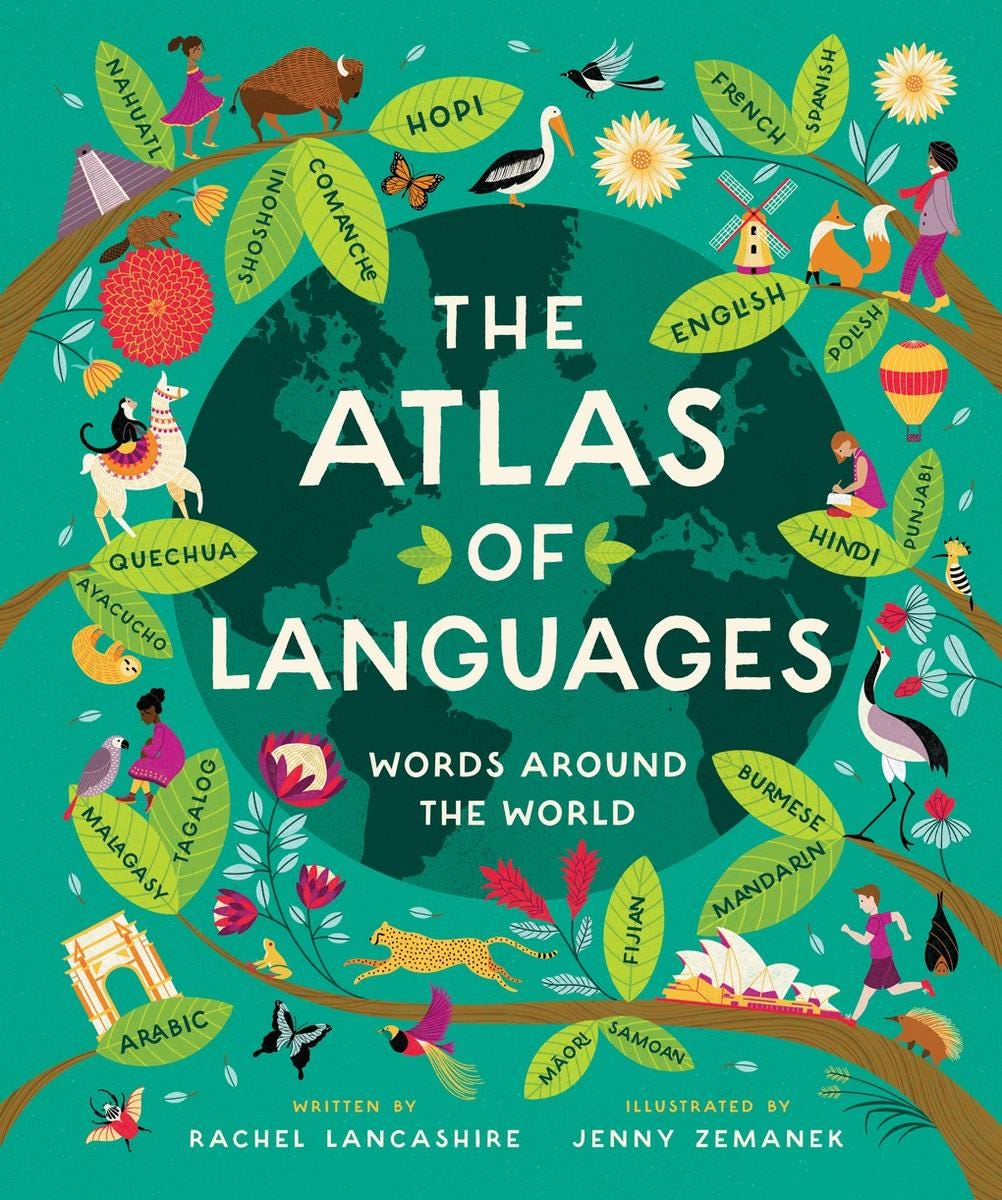
In anticipation of the release of My Language Is a Garden on February 17th (the first day of Ramadan), I went out searching for a fact book about languages that I could take along with me on school visits and readings. Lucky for me, Lucky’s Books and Comics on Main Street had a copy of this recently published atlas of languages, whose beautiful illustrations of living languages pairs so perfectly with the theme and artwork of my own title.
The atlas begins with a general overview of languages around the world, with an explanation of how European languages spread worldwide through colonization, which in turn led to the erasure of Indigenous languages from the land. Today, there are at least 7,100 languages, “but perhaps as many as 8,500.”
I was already aware that approximately half of these are expected to be extinct by the turn of the next century, but I was not aware that “95 percent of all languages are spoken by only 3 percent of the world’s population.” It puts into perspective just how much heritage we stand to lose in a just a few decades.
The Atlas of Languages is organized by continents and language trees, with Africa represented first. Countries are marked in tiny capital font whereas languages are written in variety of large and medium font sizes, with only the first letter capitalized. With some focus and attention, a reader’s eyes adjust to the crowded, vibrant map of ecological and cultural life throughout the continent. Arabic is given the most space, textually, as it is generally considered to be the language with the most speakers in Africa. Fulfulde, Swahili, Amharic, Oromo, and Somali are also prominent.
Fun facts to learn from this section:
Nigeria is home to over 500 different languages.
With around 1400 languages, the Atlantic-Congo language tree is the biggest in the world by number of languages, and the most-spoken Indigenous African languages all belong to this family.
After Africa, the book moves on to Europe then Asia and Oceania. It’s important to note that continents have other names in other languages and that industrial systems prioritize European understandings of lands and waters.
I wish the book had sourced a list of alternative names for the continents from the languages that live within the land. Many would probably conceptualize the lines of the land much differently, or even not have a concept of borders, which is why colonial institutions and literature prefer only to mention those names for geography that stem from European discourse. I appreciate that the atlas includes the name Palestine, when referring to the area of western Asia in which Arabic is spoken, but Israel is mentioned first in an apparent effort to placate all understandings of the region.
Due to its willingness to grant legitimacy to a violent, apartheid settler regime, especially after this regime created the worst invention in human culture—a live-streamed genocide—the book’s team does not get a full five stars from me.
The matter of lands and the industrial apartheid system the English language enforces on them around the globe, ruins most efforts to learn about human heritage. There is a system of violence in place to make sure some place names stay and others are erased. Languages and ecosystems are dying because of industrial apartheid systems, which are policed by the military industrial complex, but this reality is never mentioned in books like these. In order to preserve all the heritage now archived within the pages (as if writing things down were enough to keep people alive), the military industrial complex will have to be dismantled as a first, not final, step toward preserving life on this planet.
Institutional languages currently have the greatest chance of survival or generational success, but since the institutions which utilize these languages do not stand behind their principles with responsible action (for example they do not stop the production, sale, and transfer of weapons to genocidal states and tyrants) their languages are now suffering moral failures which will lead to cultural, political, and environmental disasters. So its anyone’s guess which languages will survive the ruinous future being built by industrial mercenaries around the world who are in service of the Empire of the Machine, which has become the primary cultural heritage of European colonizers.
Please, please, please put your efforts of language preservation in your children and nature, not nuclear-armed states, surveillance technology, and ragged politicians.
Despite not mentioning the major threats facing languages and human survival today, this atlas offers much reason to cherish the lands and people that have existed throughout time. Here is a random collection of facts that I found interesting.
The island of New Guinea alone is home to as many as a thousand languages. (pg.65)
In 2002, the president of Turkmenistan decided to rename all the months of the year, naming January after himself. Two years after he died, the old names were restored. This goes to show that language changes don’t always work. (pg. 61)
Sanskrit is a sacred language in Hinduism, Jainism, and Buddhism. It is still used daily by a few thousand people in India, mostly for religious purposes. (pg. 58)
The only other living languages in the Japonic language family are eleven languages that are spoken on the Ryukyu Islands, which are all in great danger of dying out. (pg. 54)
Malta is the only country in the European Union that has a language from the Afro-Asiatic language family as its main language. (pg. 37)
Hawaiian is the language of the Indigenous people of Hawai’i. It has 13 letters: A, E, H, I, K, L, M, N, O, P, U, W, and the ‘okina. The ‘okina is pronounced like the pause that you hear in the middle of “uh-oh.” (pg. 67)
The Khmer language has the largest alphabet in the world, with a total of 74 letters. It is spoken in Cambodia. (pg. 48)
Mandarin is the biggest language in the world by number of people who speak it as their native language (1.4 billion speakers). Around 200 million people speak it as a second language. It is spoken in China, Taiwan, and Singapore. (pg. 52)
Quechua was the language of the Inca Empire, and around 35 great-great-great-great-grandchildren of the language are still spoken to this day. (pg. 85)
And here is a very short list of other recent books that feature a language or cultural history.
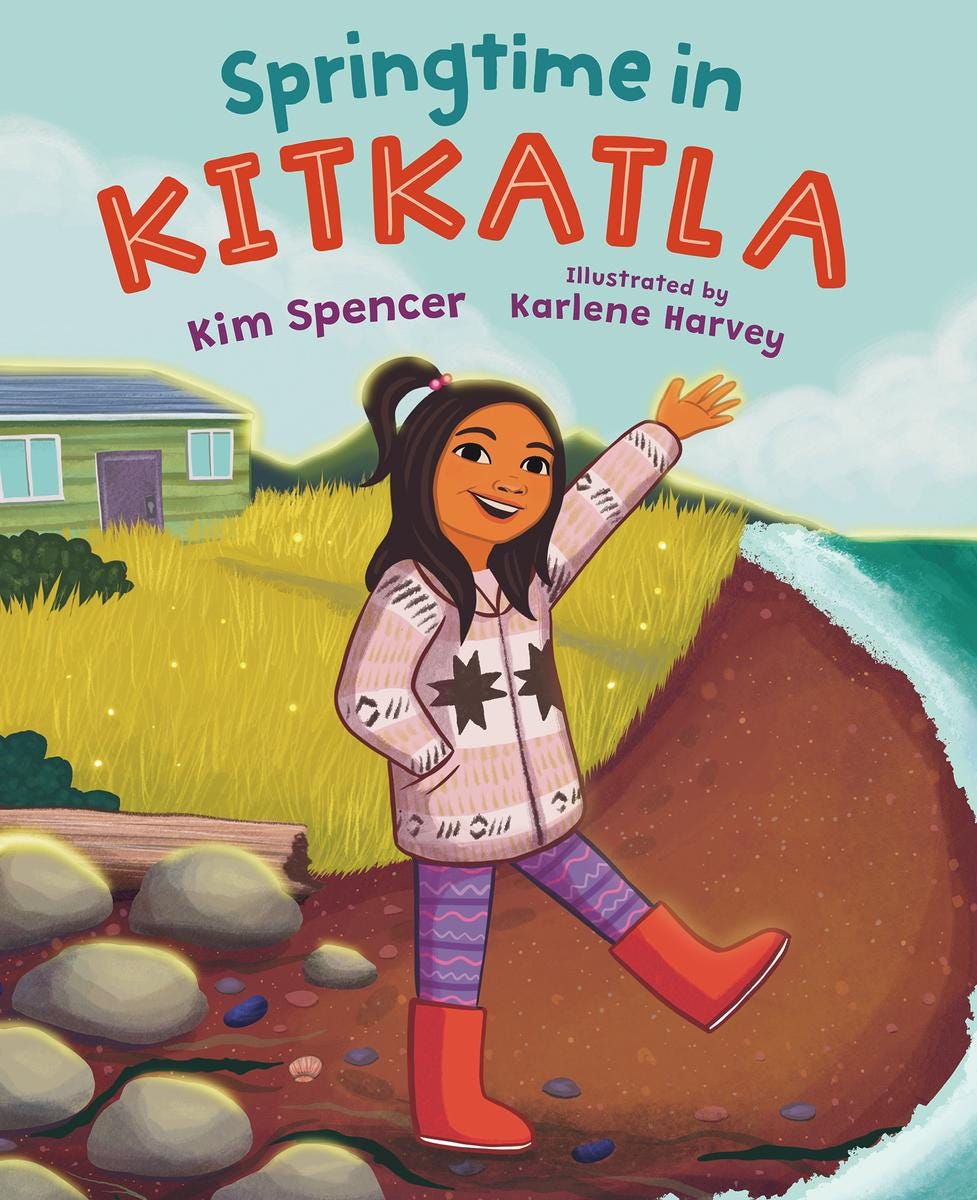
I was disappointed that hardly any of the Indigenous languages of the Pacific Northwest were represented in the atlas, but Kim Spencer has a picture book coming out that features some words in Sm’algya̱x, so I will preorder a copy of Springtime in Kitkatla as a first step in filling in the gaps.
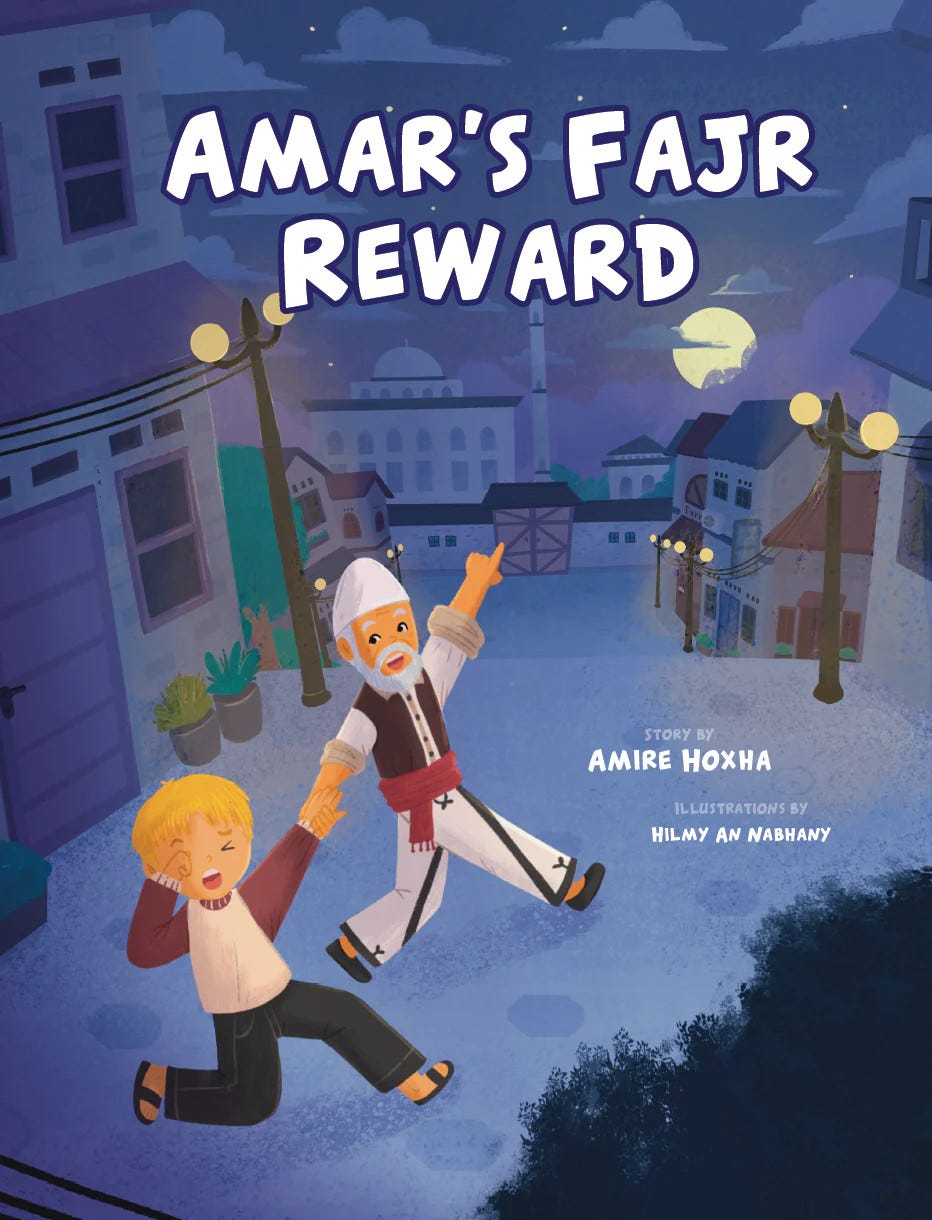
Amire Hoxha’s Amar’s Fajr Reward offers a few words in Albanian. Hoxha is originally from Kosovo. “The lack of representation of Muslim Kosovars in the Muslim kid-lit space pushed her to write her first book.”
Some facts I learned about Albanian from the atlas….
“Because it is not closely related to any of the other Indo-European languages, the Albanian language has a whole branch to itself. Spoken in Albania, Kosovo, North Macedonia, and Montenegro. 7 million speakers.” (pg. 36)
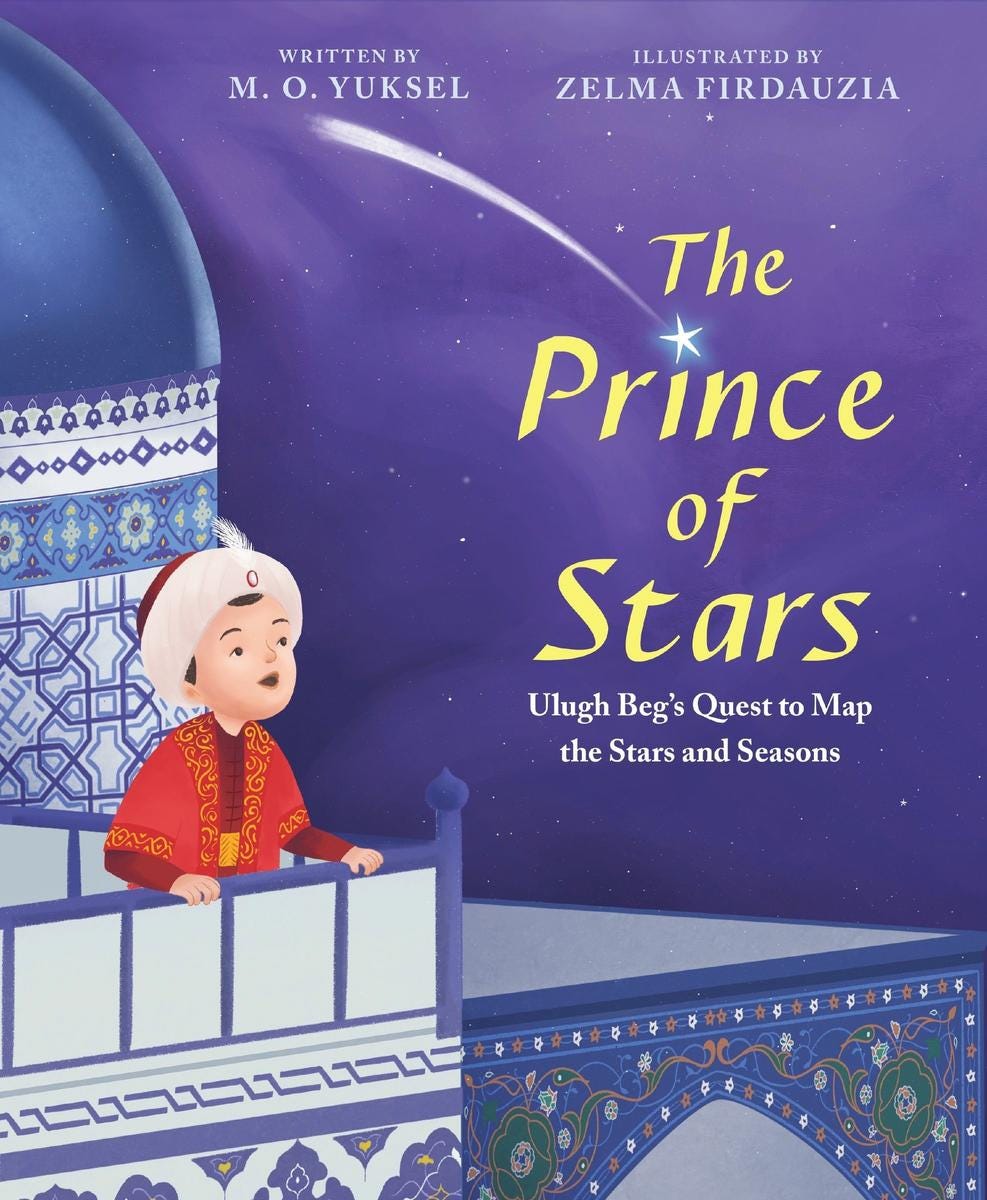
M.O. Yuksel explores Uzbek heritage in The Prince of Stars. Ulugh Beg, “the great prince” spoke Arabic, Persian (Farsi), Chagatai Turkic, Mongolian, and Chinese! This picture book tells the story of the prince’s scientific interest in the stars and the building of the Ulugh Beg Observatory in Samarkand in 1424.
Facts about Uzbek from the atlas…
“Spoken in Uzbekistan and northern Afghanistan. 31 million speakers. Kichkina demang bizni, ko’tarib uramiz sizni is a useful rhyming phrase if you’re a young Uzbek speaker. It means you should never underestimate kids (literally, “Don’t call us small, we will win”).”
I’d like to end with some good news to share. My Language Is a Garden received a starred review from Booklist!
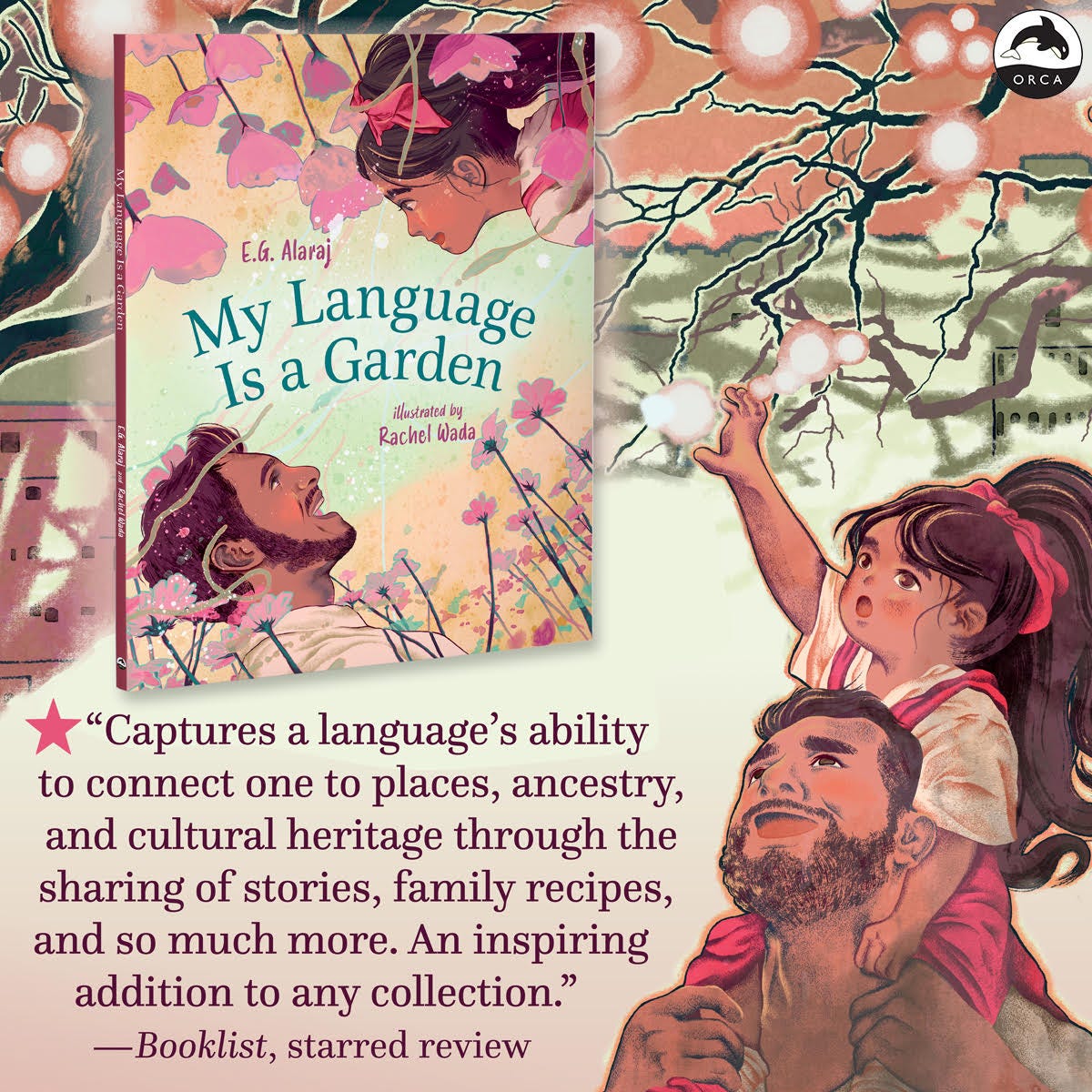
If you feel inspired, please preorder a copy of my book before its release. Copies have recently come off the press and shipments will begin soon. This book is designed to encourage children of any language to plant the seeds of their heritage in the world.