

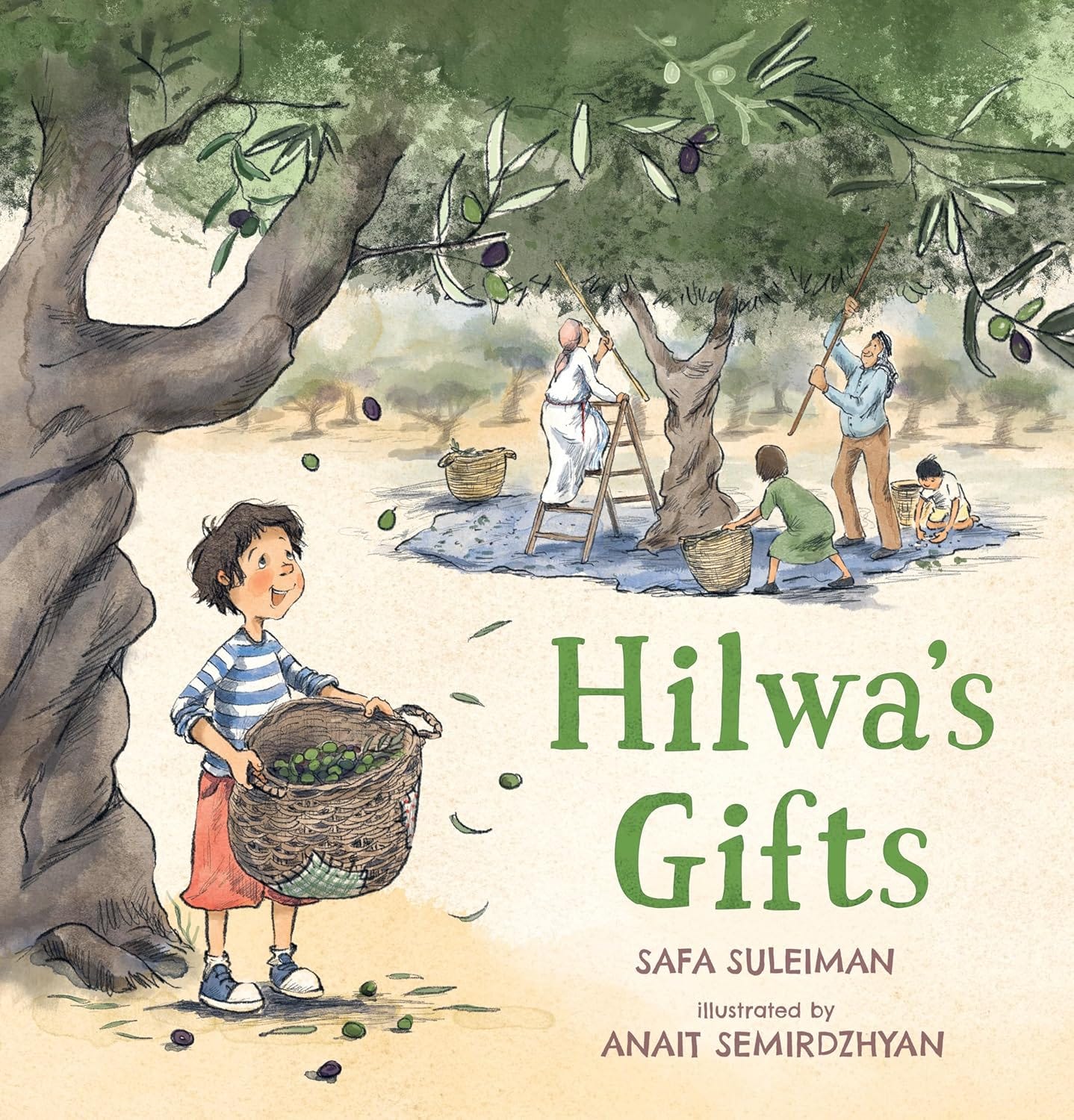
“A gentle, loving immersion into the gifts of the olive tree and Palestinian culture.”
Olive trees are gentle, strong, resilient, and enduring. Their fruits are bitter-sweet like medicine. The sacredness of their beauty is reflected in sage-green leaves. The worldliness of their beauty is reflected in the hard, ashy colour of their trunks. An olive tree’s beauty soothes the eyes and calms the mind. Proximity alone improves focus, but to engage in harvesting is to connect mind, body, and soul to the life-giving properties of a sacred plant.
Written by Safa Suleiman and illustrated by Anait Semirdzhyan, Hilwa’s Gifts is a gentle, loving immersion into the gifts of the olive tree and Palestinian culture. Olives, olive oil, soap, and fire are material gifts that come from Hilwa, a fruitful olive tree in a Palestinian family’s grove. For Ali, who has come from America to visit his relatives in Palestine, the rigorous process produces much more. Within the song of the harvest (“zeitoon ya zeitoon”), the beating of the branches, the gathering of the olives, and a picnic lunch made up of beloved local foods, Ali’s connection to his family and culture grow deep and meaningful.
With economy and purpose, Safa Suleiman draws immediate attention to the bond Ali has with Hilwa, who was planted by his grandfather and great-grandfather. Ali has climbed Hilwa’s branches and enjoyed the shade of her leaves before, but he’s never witnessed the harvest. At first, he worries the aggressive process will harm his beloved tree, but a gentler method yields little. Joined by Teita and his cousins, a collective shaking of the branches causes Hilwa’s gifts to rain down in abundance.
Anait Semirdzhyan’s digital artwork does an equally masterful job establishing the scene and progressing to the harvest. The beauty and activity of a Palestinian village flow seamlessly in an energetic pattern of full and reduced scenes. Everything evokes the ancient landscape and its living human heritage.
Thank you, Safa Suleiman, for sharing Hilwa’s Gifts with me in advance of its release by Candlewick on April 1st, 2025. Reading it to my children inspired many personal connections to the story. They immediately saw what looked like their own Seedo’s house, which is situated in a Palestinian village near Bethlehem.
In the artificial boundary of the village, where olive groves meet containment fences, there lives an ancient olive tree named Al Badawi. It is thought to be between 3,000 and 5,500 years old, making it potentially the oldest olive tree in the world. Al Badawi is tended and protected by a local farmer and his family. When we visited the grounds in the spring of 2023 and spoke with Al Badawi’s caretaker about the ancient tree’s needs and the needs of the village, a deep sense of responsibility and urgency took root in our hearts. While I have not been able to cultivate those emotions into real actions as yet, receiving Hilwa’s Gifts from Safa has planted new roots of love and inspiration into my heart. One never knows what destiny will bring, but I do know that Al Badawi, the ancient olive tree, has been a witness to the occupants of the land. Generation after generation, their hands and their appreciation have sustained its presence—its permanence.
For those who don’t know the Islamic connection with olive trees, the olive is one of the sacred fruits mentioned in the holy Quran. In the revealed chapter named “The Fig,” Allah uses symbolism to express the meaning of human existence in this world. Swearing by the fig and the olive (of Jerusalem), by Mount Sinai, and by “the secure city” (Mecca), Allah says he has created humanity in the best form and that he will reduce us to the lowest of the low, except those that believe and do good works. For them, there will be everlasting rewards. What better representation of Allah’s gifts to mankind, of his everlasting mercy, than the olive? And what better witness than the olive tree has stood against the ruin of civilizations? No material or intellectual advancement has afforded any of us the ownership of existence. Our civilizations rise and they fall, but the signs of God remain. Nothing can replace the order of God. Not humanity. Not our inventions. Not our wealth and technological power. Not our civilizations, nor their declines.
God has no rivals.
But don’t forget your responsibility to believe and do good works. Planting and preserving the olive tree and its cultural and material gifts is an act of worship as well as a stubborn refusal of spiritual, intellectual, and physical diminishment. The terrible shyness of life that sometimes overcomes us when the world is rife with extreme violence and despair might be defeated by some collective shaking of the branches and joyful songs, along with the knowledge of the ages and God’s purpose for mankind. Palestine is a remedy, not a problem.
Zeitoon, ya zeitoon.
Surah At-Tin - 1-8 - Quran.com
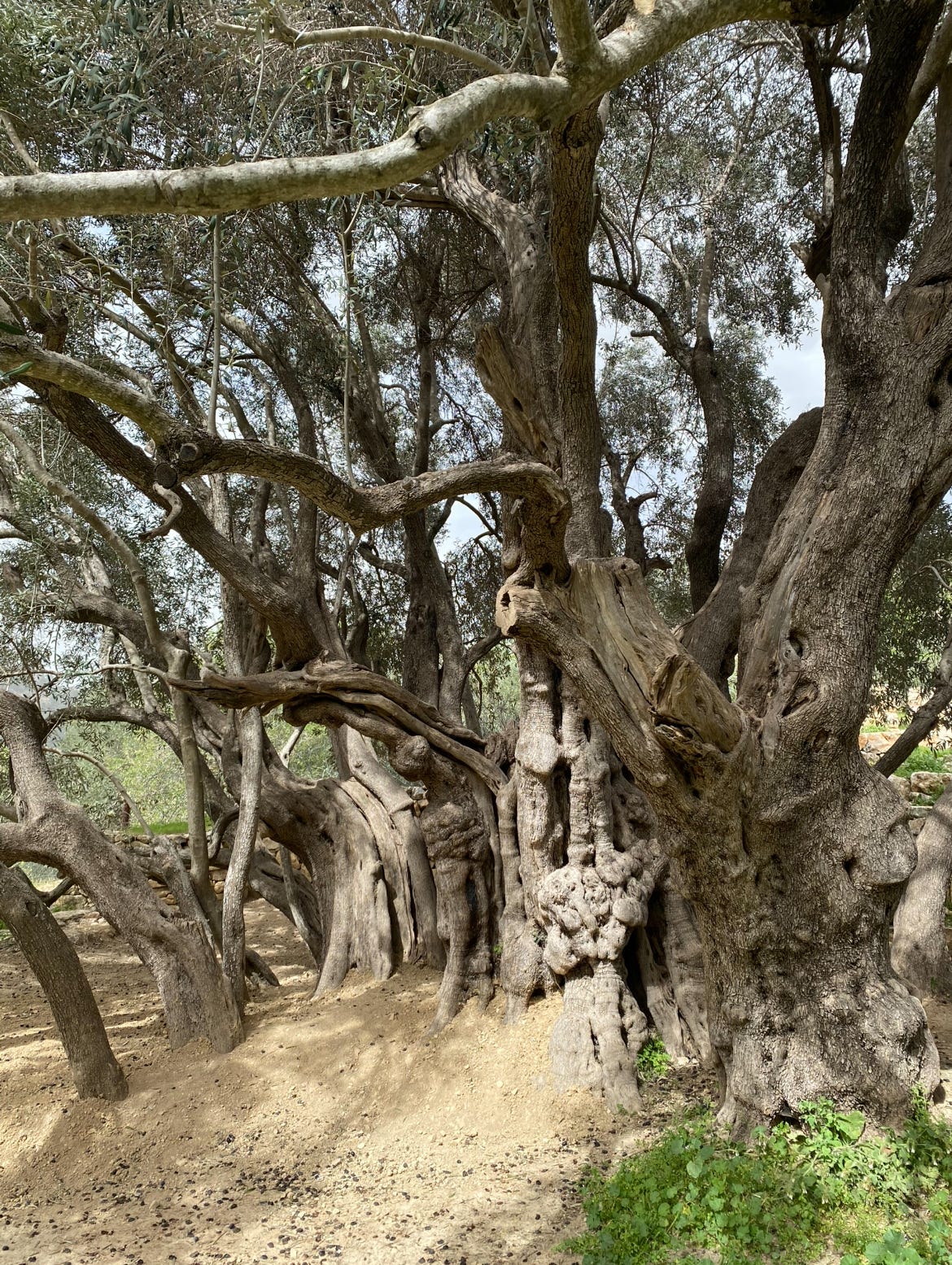
Al Badawi, March 2023 (photo taken by me)
Love this review & this book!