

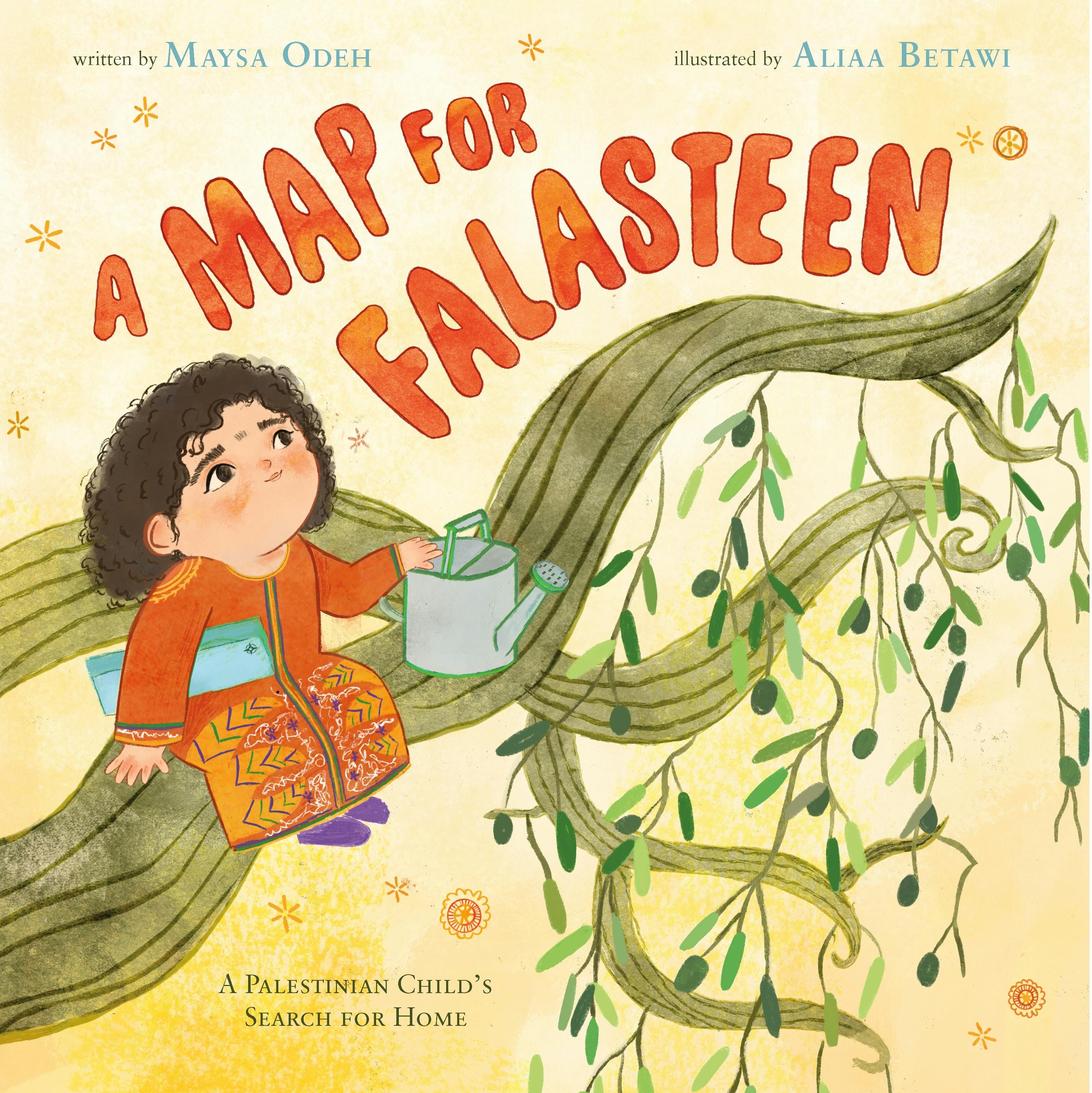
There is so much significance packed into this powerful picture book by Maysa Odeh and Aliaah Betawi. Their creative collaboration will require an encore or two. Or three or four. Brought to tears by the dedications, I had first to dry my eyes and restore my breath before continuing on in the narrative.
In a presumably American classroom, students are asked to find their countries of origin on a map. Falasteen cannot find Palestine. Her teacher isn’t sure that it exists, causing confusion in Falasteen’s mind. At home, she questions her family members about the absence of Palestine on the map. Each family member gives Falasteen a way of understanding Palestine and the family history of exile. Grandpa (Jido) draws a map. Grandma (Teta) hangs the key to the house she left behind upon Falasteen’s shoulders. Mama describes the collective memory that lives in the hearts of Palestinians worldwide. “Some people live in countries. Some countries live in people.”
For readers who wish to carry Palestine in their hearts and minds, there are lots of little gems to collect in the writing. I liked the poetic examples of places you can find without a map, such as your favourite trail, hideout, or birds nest. The description of millions of hearts beating like dabke drums was also lovely. For me, Arabic music is soul music. It’s rhythms move like wind through the body, carrying away sadness, anger, and pain.
As for the artwork, there are so many symbolic details. I love the child’s drawings that hang between Falasteen and her teacher like a map of Falasteen’s inner world that is in danger of being erased by a teacher’s lack of knowledge. I also adore the way Palestinian houses and buildings resembled potted, vining plants. The most powerful image is that of Falasteen’s grandmother carrying her home on her back as she flees soldiers. It ties so poignantly with the illustrator’s dedication.
Despite the joy and love that went into this book, it will no doubt be challenged or disparaged by opponents of human dignity and peace. If the world would allow Palestinian voices to speak freely, we would learn so many things about life, survival, love, and the human spirit. Knowing how dangerous and difficult it is to talk openly about Palestine, I am grateful this book exists and for the personal risks its creators have taken to bring it to life.
I cannot wait to read this!