

“As I write, highly civilized human beings are flying overhead trying to kill me.” —George Orwell, "The Lion and the Unicorn: Socialism and the English Genius
In my few decades of stumbling around the English language looking for “the right words” to prevent people in my high-tech society from condoning the mass murder of other human beings, I’ve not found many authors with sharp enough tongues to cut through English’s hypocrisies and delusions of superiority. Most of what I did find came from generations before mine: Malcom X’s autobiography, George Orwell’s essays, Edward Said’s Orientalism.
Another book that I poured over, and the most powerful one at my disposal, was the Quran. Its ability to reduce by a single verse our great, prestigious societies to meaningless dusty rubble was something I had not found in ANY form of writing or speech. Echoes of its wisdom could be found in the broken or highly perfected English of my Palestinian relations. From the refugee camps to the academies and political offices, Palestinians are excellent orators of truth and defiance. No matter how vile, how dehumanizing, how suffocating the occupation becomes, one gets the sense from speaking to Palestinians that tomorrow or even tonight the oppression will end.
Oh how my ear craves Palestinian English—an English firmly rooted in the Quran, with its strong yet gentle manner of negotiating human affairs. It is the only form of English today that rings true to me. It does not vie for the subordination of others, nor does it seek to dominate the planet with increasing cruelty and callousness. It chooses the right marks for defiance and safeguards the rest with that sense that tomorrow, tonight, the oppression will end.
What would English be in this hour, in this point of history, without the Palestinian men and women that stand in the road waving flags, waving arms, waving the bodies of martyrs at the camera, waving their voices against waves and waves and waves of oppressive violence?
Where is our culture heading? Our English-speaking culture that kills other nations softly with its song, where is it going? Over what edge, what cliff, what abysmal defeat do we plunge?
If the English language is to persist as a system of meaning-making and inspiration, the verbal knot of colonial and decolonial violence must be untied. By failing to confront our hypocrisies and the systemic violence they uphold, we have impoverished our societies of everything good and meaningful. We languish in criminality and futility while those we oppress provide what we cannot: answers to our despair and alienation from life.
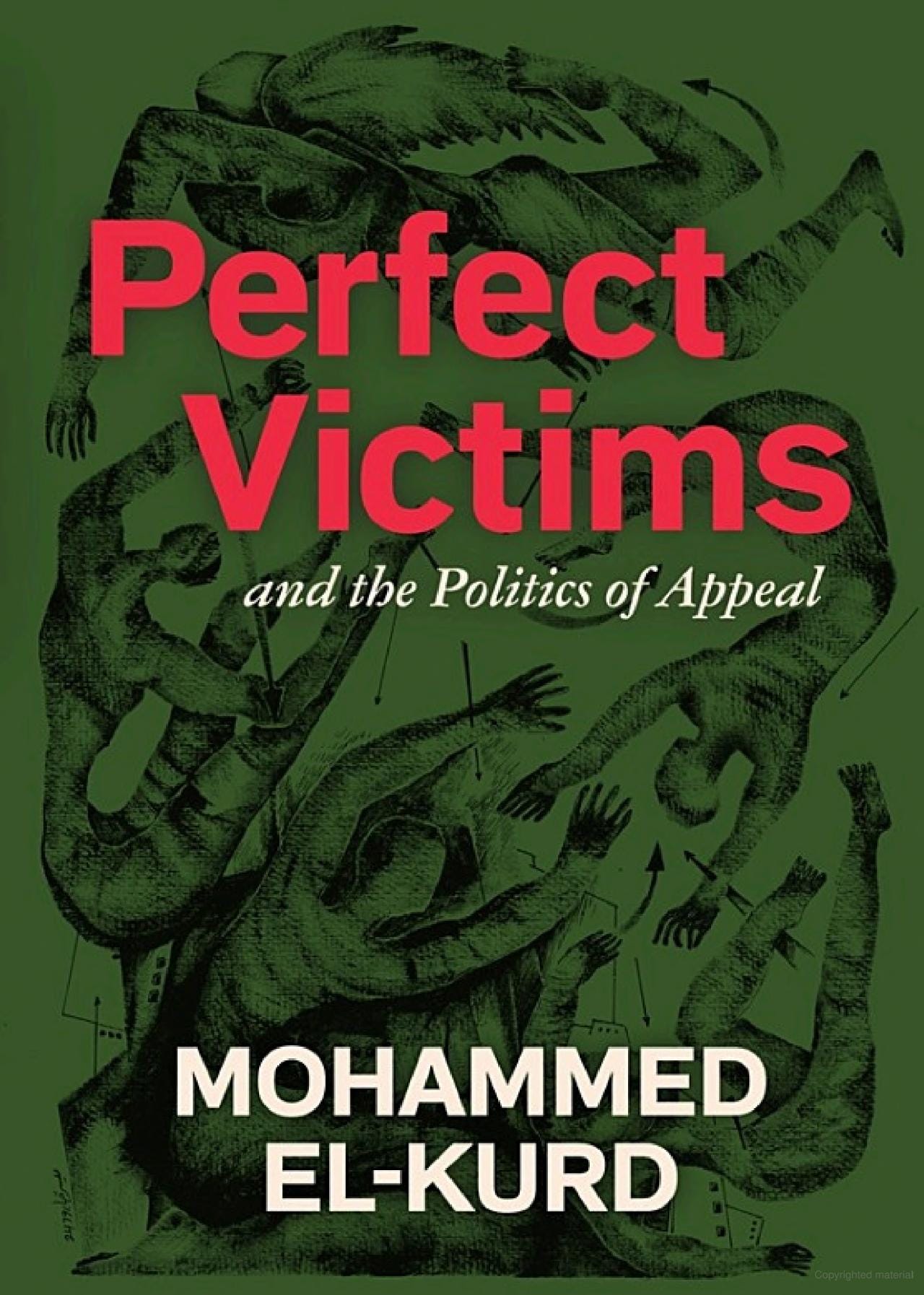
Mohammed Al-Kurd’s recent book Perfect Victims reminds me of the autobiography of Malcom X. The sharpness of his tongue reveals a racket of racial hierarchy in which the dehumanized must perform strict forms of humanity for English audiences and still be condemned for not being human enough to deserve life. Ripe for grandmotherly tongue-lashing, English is put on trial. Its metaphors, assurances, duplicities, blinds spots, and delusions of moral supremacy are shown for what they are—tools of subjugation no different from the tanks, guns, snipers, soldiers, apache helicopters, drones, quadcopters, barriers, checkpoints, surveillance towers, prisons, blockades, bombs, and chemical weapons that have choked the life out of the Palestinian population for decades.
“Moreover, the discourses surrounding “congruence” and “moral authority” act as though colonialism has not erected barriers of irreconcilability (as well as literal cement barriers) that separate us from humanity. We are dehumanized, thus we are incapable of humanizing ourselves. Appealing to a “moral universality” cannot save us, for there is no room for us in that morality. Zionism’s objection to the Palestinian People isn’t about how we exist but that we exist at all.” —p.42
“I once credulously believed that our testimonies would be considered credible only once we attained “respectability.” Colonial logic gaslights us to believe that it is our shortcomings, not colonialism itself, that stand between us and liberation. And so we spend our years on a circuitous journey toward an impossible atonement. We accept starting the story at “Secondly.” But in truth, and to state the obvious, nothing renders me killable. Before I threw the rock, they stole my land. Before I picked up the rifle, they shot my loved ones. Before I made the makeshift rocket, they put me in a cage. What I read cannot be used as a pretext to kill me, even if I filled my library with books written by psychopaths, interchangeably stacking copies of Mein Kampf and Hillary Clinton’s Hard Choices.” —p.113
“The very moment that the Palestinian exits the womb, he is “unchilded”—flung away from childhood by a “machinery that exists everywhere and always” and treated as both a good-for-nothing nobody and a dangerous ticking bomb at once. The Palestinian is unchilded the first time he talks to his uncle from behind glass or asks his aunt about the tin roofs or tries to decipher what has been erased from the street signs. Or when he embraces his father by a concrete cylinder, telling himself that the explosions he is hearing are just fireworks. Or when he plays soccer on the beach. Somewhere along the line the Palestinian child will stumble across the phrase “legally killed child” used to describe his slain peers: a Yale professor will write a column in the Atlantic about how “it is possible to kill children legally.” And the sniper follows orders.”—p. 149