

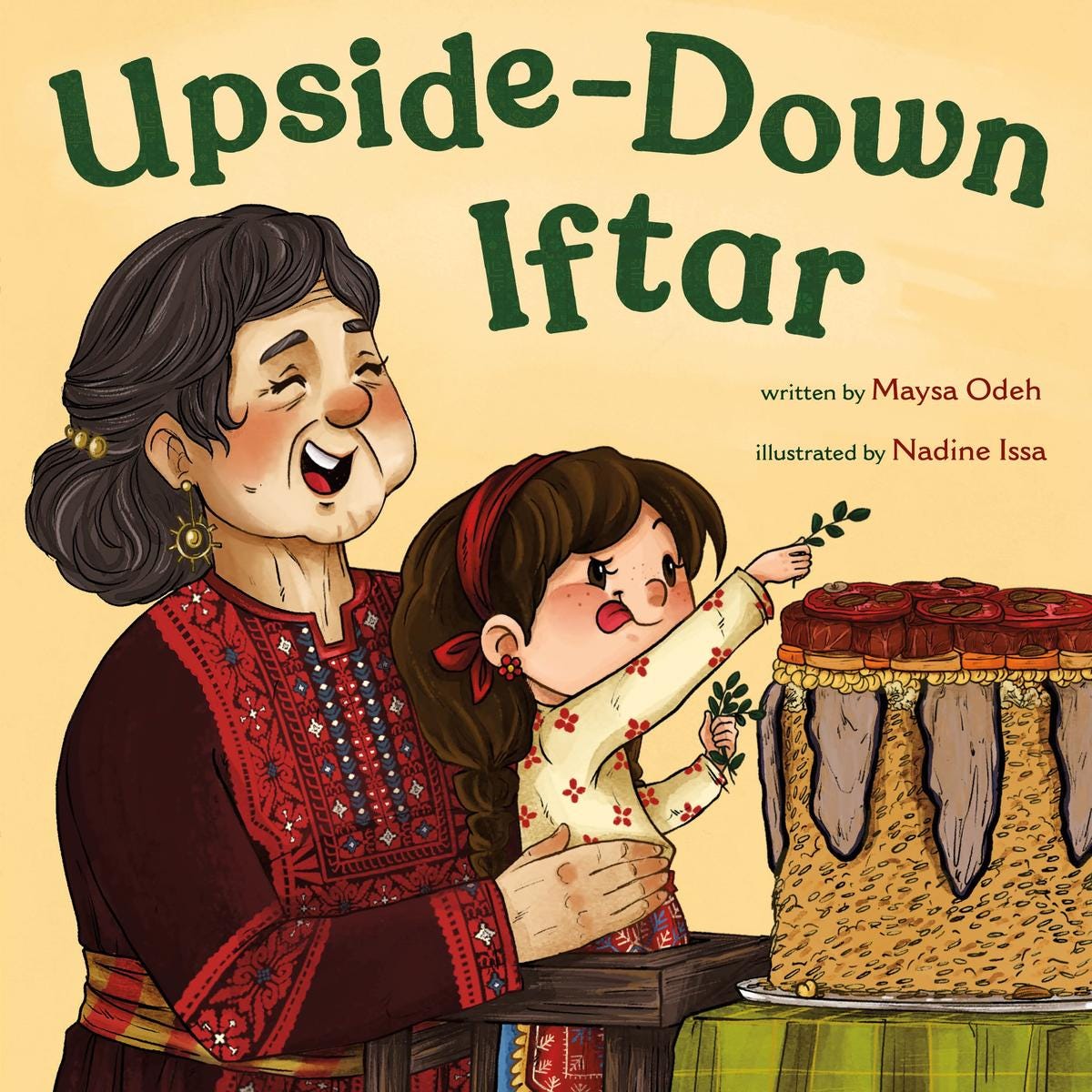
This delightful tale, set during Ramadan, has a lot of underlying humour that flips to the top if you’ve had the good fortune of being part of a Palestinian family. Cooking at the bottom of the plot is Teta’s psychological angst over a growing list of ingredients. As a quintessential Palestinian grandmother, she has oodles of patience for the time and effort that will go into making this beloved dish for the family, but Teta’s persistent “Inshallah” carries the subtlety of a purist’s side-eye against too many innovations. Teta is trying not to faint, her grief not caused by age or medicine. Her granddaughter Malak’s excitement seems to be the only thing keeping Teta on her feet.
As the author, Maysa Odeh, mentions in the back-matter of the story, some purists “consider it a travesty to incorporate more than one vegetable.” Backmatter also includes a recipe, cooking instructions, and suggestions for garnishes.
Illustrations are as warm and inviting as this family-oriented story of a beloved Palestinian dish. Rich in decorative detail, like a hand-sewn tatreez garment, Nadine Issa stitches together the colours, textures, and patterns that embody Palestinian love for home and family. Wherever readers cast their eyes, there is beauty and adornment, richness and warmth that naturally coalesce when hands and minds are guided by the heart.
A perfect blend of artwork and storytelling, sure to top bookseller lists during Ramadan.
Maqlouba is one of the first Palestinian dishes I ever tried to make. I was twenty-four years old and barely capable of cooking an egg. You can imagine the result. At the time, you could hardly find any recipes in English on the internet. I resorted to YouTube. The “chef” recommended fried ground beef, carrots, and peas, which is more similar to ouzi than maqlouba, but I trusted them. I can still recall the look on my husband’s face when he viewed that enormous catastrophe meant to be eaten by only the two of us that night in Jordan. He ate two bites at most then suggested we head to the city center for argela. He ate well at the restaurant, lol.
If you’ve ever flipped a pot of maqlouba before, you’ll know the angst that goes into it, especially if you’re the cook. If you didn’t put enough water, the ingredients at the bottom might be burnt or the rice might be dry and hard. If you put too much liquid, the rice might be mushy like pudding.
If you’re adding too many vegetables and meat, like I usually do, you’ll need a lot of liquid to cover the rice, so you’ll want a grain that can hold up. The other day, I made maqlouba (it’s still the dish I’m least skillful at making…I can make almost everything else decently) and realized I only had chicken and carrots to go with the rice. It ended up being my best attempt to date, but the purists will surely not believe me.
More reviews for Ramadan on the way, inshallah….