

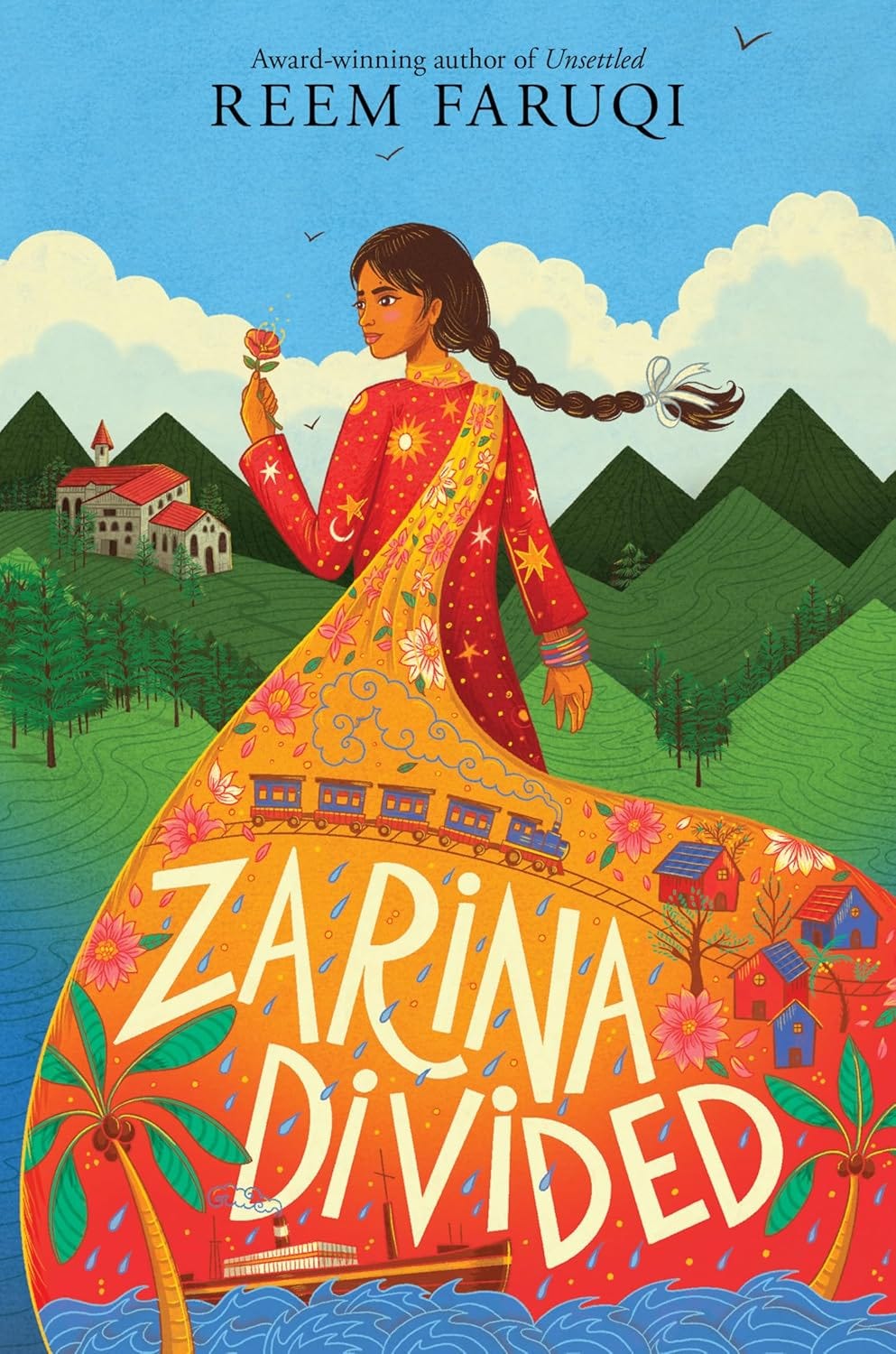
First of all, allow me to congratulate Reem Faruqi for the release of Zarina Divided, which was published by Harper Collins in March of this year (2025). It is a timely narrative written in verse for children, aged 8-12 years. Shortly after the book’s publication, in May to be exact, the legacy of apartheid between Pakistan and India once again reared its ugly head in a volley of missiles. It was also in March that the Apartheid Entity in historic Palestine intensified its use of starvation as a weapon against civilians in Gaza. In May, it advanced this weaponry of starvation by replacing international aid agencies with militant industrial mercenaries.
In simple terms, the colonial infrastructure of the former British Empire, its forced marriages and divorces, is all coming apart in the same violent fashion that it was constructed together/apart. It did not hold. It will not hold. And our children will continue to pick up the pieces, if any remain.
Apartheid is disintegrating and to keep it from falling apart, stronger and more brutal forms of apartheid are given global application, compartmentalizing or warehousing humanity into smaller and smaller zones of life. Perhaps this explains the author’s use of verse to relay the shattering of her grandmother’s world in 1947. One attempts to comprehend the whole through the assemblage of small verses.
Kirkus described Zarina Divided as “an ambitious attempt to render sweeping changes in the birth of a nation that doesn’t coalesce.” I had to read the description a few times, wondering if the reviewer was speaking of the nation not coalescing or the novel. How can the story coalesce when the legacy of apartheid continues to devour history instead of supporting it? Rather than draw lines and take sides between people, the author attempted a careful journey through the history of partition and its legacies of compartmentalization in thought and reality.
Zarina Divided is composed of four sections, which are classified by date and geography. Its main character is a fictional representation of the author’s grandmother, whose father (the author’s great grandfather) was influential in the founding of Pakistan. Throughout the narrative, the main character exercises and resists her urges to compartmentalize the social and geographical upheavals that take place. The author examines these impulses rather than encouraging one over the other. When so many divisions have already taken place, further dividing might beg some hesitancy, or so the narrative seems to suggest.
“When there’s space in your heart, there’s space to accommodate.”
But what if the political system you live in is designed to squeeze the space out of your heart? After partition, what remains of the heart and its generous chambers?
I hope young readers will pick up on the cult vibes, emanating from the white teachers at Zarina’s boarding school. With carefully crafted scripts for everything, they come across as open-minded, caring teachers, but the school is a monocultured replica of British life on lands that have long been diverse. Before partition, how many languages were spoken? How many religions were practiced? How many cuisines were mixed? All to be replaced by a mixed group of people eating porridge and speaking English!!! ya Allah.
Meanwhile, at the same period of time in the Americas, boarding schools were “residential schools,” designed to murder any indigenous soul that stepped inside.
Since I am not a revolutionary intellectual, allow me to close with the words of someone who was.
“A world compartmentalized, Manichaean and petrified, a world of statues: the statue of the general who led the conquest, the statue of the engineer who built the bridge. A world cocksure of itself, crushing with its stoniness the backbones of those scarred by the whip. That is the colonial world. The colonial subject is a man penned in; apartheid is but one method of compartmentalizing the colonial world. The first thing the colonial subject learns is to remain in his place and not overstep the limits.” —Frantz Fanon, The Wretched of The Earth.
To summarize, Zarina Divided invites the inheritors of colonial partition to understand the physical, intellectual, and emotional barriers that were set in place by partition and which now inhibit communal coalescence.